Showing posts with label Research. Show all posts
Showing posts with label Research. Show all posts
Tuesday, 31 March 2015
Audience Research

Friday, 16 January 2015
Digipak and Magazine Advert
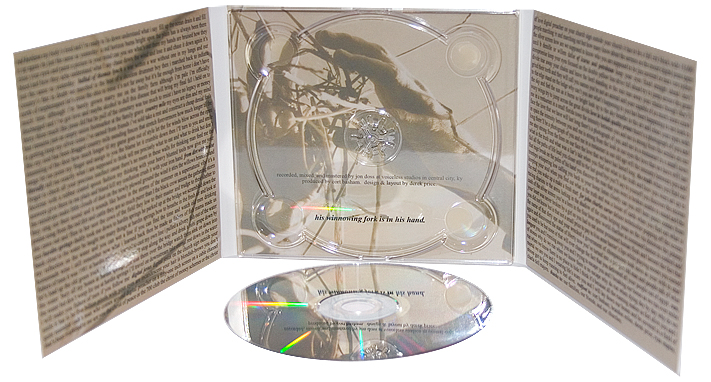 Digipaks typically consist of a gatefold book-style paperboard
or card stock outer binding, with one or more plastic trays capable of holding
a CD or DVD attached to the inside. It means the cd comes in a cardboard
flip-out case rather than a standard plastic hinged case.
Digipaks typically consist of a gatefold book-style paperboard
or card stock outer binding, with one or more plastic trays capable of holding
a CD or DVD attached to the inside. It means the cd comes in a cardboard
flip-out case rather than a standard plastic hinged case.
Digipak-style packaging is often used for CD singles or
special editions of CD albums and the tall DVD Digipak (DVDigipak)is used as a
premium package for DVDs and DVD sets.
- Six Panels
- Spine
- BarcodeTrack
- ListDisk impression
- Membership postcard/flier
- Band info section/booklet
- Free image/poster
What you would look for in a digipak would be the name of
the artist and the album name. It would have to have the right font, size,
colour and position, to attract certain kinds of customers. The images put into
a digipak, would also have to be positioned well. The colours have to represent
and have meaning, as well as there has to be a theme, this all has to link back
to the genre of the music.

Background
 The background of the FAME album, is very vibrant one of different colours, show the different sides of his personality. As well as attracting people, as his target audience is young teens to mid twenty's. The background is full of many photos of the artist which is overlapped with edited images of cartoon images, which represents Chris Brown the artist. This shows his other interests outside of music. This also links back to the genre of the artist, which is Rnb&Hip hop which gives the audience an urban feel to the digipak. The main photo of the artist, is him staring head on at the camera, which seems as if he is staring confidently at the customer.
 Name of the album
The title of the album 'F.A.M.E' that has two meanings which stand for 'Forgiving All My Enemies' and 'Fans Are My Everything', is written in large graffiti print at the bottom of the front cover. The title is in white which boldly stands out over the colourful background, which is easily seen. It is also dripping in spray paint, which links back to the artists hobby.

Theme
The theme of the 'LOUD' album is the the colour red and roses, this continues with her bright red hair and lips. Rihanna is an sexual artist which is represented by the colour red, as red is an intense colour which symbolises passion, this is an refection of the artist. She is the main attention of the digipak as it is a extreme shot if her face, attention is being demanded again, this reflects the artists persona. The front is spread out and white, which represents isolation and distance, this is the artists feel to the how album and her emotions. This links to the background of the digipsk, as she is laying beautifully against a roses.

Theme
The artist uses colours of light blue and white which shows innocence, this is also shown through her white shirt as she is covered up to her neck. Lana Del Rey in white attracts the audience's attention in standard bold font, which again is simple but affective as she isn't forgotten. The artist is unique, this is shown through her vintage fashion and retro style music with again allures the audience. Although her sex appeal is still shown through her sensual voice and her red lips. As her music also reflects this, the juxtaposition of her makes her more interesting and appealing to the audience.
Monday, 12 January 2015
Narrative
Narrative is the way a story is organised. Elements of narrative is:

 Todorov's theory can be applied to the movie Scream, which came out in 1996. Scream
offered a self-referential approach to horror by featuring a cast of characters
aware of the conventions of the horror film genre and able to use them to
survive. The film focuses on teenager as she comes under attack from a
mysterious character dubbed Ghostface while dealing with the anniversary of her
mother's murder.
Todorov's theory can be applied to the movie Scream, which came out in 1996. Scream
offered a self-referential approach to horror by featuring a cast of characters
aware of the conventions of the horror film genre and able to use them to
survive. The film focuses on teenager as she comes under attack from a
mysterious character dubbed Ghostface while dealing with the anniversary of her
mother's murder.

Equilibrium - Casey Becker is at home relaxing with no care in the world. She is about to watch a movie. Then she gets a phone call.

Disruption or disequilibrium which is the killer. As there is a shift in the phone conversation which becomes frightening. Casey is aware of this and becomes scared. She is chased and then brutally killed. This straight away makes it obvious to the audience that her killing was random.

Resolution is that Sidney remains alive throughout the whole film.The new equilibrium of the film is that although Sidney survives, she'll never be the same again. She does find her father and moves on.

Roland Barthes theory on narrative states that texts are all complex bundles of meaning, which can be unravelled to create a whole range of different meanings. For example:
An example of this would be the movie Scarface. The remake of the 1932 film with the same name. It tells the story of Cuban refugee who arrives in Miami in the 1980's with nothing, but makes it as powerful drug kingpin.
This film has polysemic text, that's why it has multiple interpretations. Some audiences view the film as a glorification of violence in this era. Another interpretation would suggest its an uplifting film of an individual who goes from rags to riches. Lastly audiences can have an interpretation of this film being only focused on the greed and consumption of the 1980's.
Barthes referred to this concept as narrative codes. The most important codes is the enigma code. This is constructed to attract the attention of the audience in which they want the mystery to be solved.

Vladimir Propp analysed folk stories, in which he identified 8 key character roles.

Syd Field studied from Hollywood films that the narrative is a three act structure, in which he calls the ideal Paradigm.
1) The set up - The first twenty to thirty minutes the hero must have a goal (enigma) before they experience a plot point (disruption).
2) The confrontation - Half way through the film, the hero's struggle will be shown. They will have to figure a way to solve their problem.
3) The climax - The final quarter of the film the hero can finally solve their problem (new equilibrium)
Claude Levi-Strauss argues his point of binary oppositions, that they start the basis of narratives. Gender stereotypes can organise binary oppositions, as well as dominant and submissive.
Dominant
- Time
- Closure
- Enigma
Tzvetan Todorov's theory of narrative:
- Equilibrium - This is the peace where nothing bad is happening
- Disruption - This is the enigma which messes up the peace
- Resolution - This is the closure which solves the enigma
- New Equilibrium - This is the change and the learning of events
Todorov's theory can be applied to the movie Scream, which came out in 1996. Scream
offered a self-referential approach to horror by featuring a cast of characters
aware of the conventions of the horror film genre and able to use them to
survive. The film focuses on teenager as she comes under attack from a
mysterious character dubbed Ghostface while dealing with the anniversary of her
mother's murder. Equilibrium - Casey Becker is at home relaxing with no care in the world. She is about to watch a movie. Then she gets a phone call.

Disruption or disequilibrium which is the killer. As there is a shift in the phone conversation which becomes frightening. Casey is aware of this and becomes scared. She is chased and then brutally killed. This straight away makes it obvious to the audience that her killing was random.

Resolution is that Sidney remains alive throughout the whole film.The new equilibrium of the film is that although Sidney survives, she'll never be the same again. She does find her father and moves on.

Roland Barthes theory on narrative states that texts are all complex bundles of meaning, which can be unravelled to create a whole range of different meanings. For example:
- Open - with numerous 'threads to pull' (everything may not be resolved)
- Closed - with only one obvious thread to gasp
- Texts that can be read in multiple ways are called polysemic texts (in accordance with audience theory)
An example of this would be the movie Scarface. The remake of the 1932 film with the same name. It tells the story of Cuban refugee who arrives in Miami in the 1980's with nothing, but makes it as powerful drug kingpin.
This film has polysemic text, that's why it has multiple interpretations. Some audiences view the film as a glorification of violence in this era. Another interpretation would suggest its an uplifting film of an individual who goes from rags to riches. Lastly audiences can have an interpretation of this film being only focused on the greed and consumption of the 1980's.
Barthes referred to this concept as narrative codes. The most important codes is the enigma code. This is constructed to attract the attention of the audience in which they want the mystery to be solved.
.jpg)
Vladimir Propp analysed folk stories, in which he identified 8 key character roles.
- The Hero (Protagonist)
- The Villain (Antagonist)
- The Donor (Provider)
- The Helper (Assistant)
- The Father (Wise Advise)
- The Dispatcher (Sends On Mission)
- The Princess
- The False Hero
Propp argued that the characters could fill more than one role.

Syd Field studied from Hollywood films that the narrative is a three act structure, in which he calls the ideal Paradigm.
1) The set up - The first twenty to thirty minutes the hero must have a goal (enigma) before they experience a plot point (disruption).
2) The confrontation - Half way through the film, the hero's struggle will be shown. They will have to figure a way to solve their problem.
3) The climax - The final quarter of the film the hero can finally solve their problem (new equilibrium)
Claude Levi-Strauss argues his point of binary oppositions, that they start the basis of narratives. Gender stereotypes can organise binary oppositions, as well as dominant and submissive.
Dominant
- Male
- White
- Middle class
- Middle aged
- Heterosexual
- Able-bodied
- Female
- Ethic minorities
- Working class
- Young & old
- Homosexual
- Disabled
Friday, 9 January 2015
Michael Jackson
 Michael Joseph Jackson was an American singer, songwriter,
record producer, dancer, and actor. He is called the King of Pop, his
contributions to music and dance, along with his publicised personal life, made
him a global figure in popular culture for over four decades.
Michael Joseph Jackson was an American singer, songwriter,
record producer, dancer, and actor. He is called the King of Pop, his
contributions to music and dance, along with his publicised personal life, made
him a global figure in popular culture for over four decades.
Michael Jackson recorded and released a cover version of
"Rockin' Robin" in 1972, which was taken from his gold-certified solo
album titled Got to Be There. It was the biggest hit from the album, hitting
no. 1 on the Cash Box singles chart and peaking at no. 2 on both the Billboard
Hot 100 and R&B charts.
Rockin Robin - 1971
The video to rockin
robin was a basic video promoting the song. It had limited sophistication and lip
synching.
The recorded and released cover version of "Rockin' Robin" in 1972. Which Michael Jackson recorded was taken from his gold-certified solo album Got to Be There. It was the biggest hit that reached number one on album and Cash Box singles chart. The Billboard Hot 100 and R&B charts.
It reached number one on both the pop and R&B singles
charts. On Billboard rock with you was the fourth biggest single of 1980’s. It
is also considered one of the last hits of the disco era.

The beginning of the music video is taken in a wide long shot of Michael dancing, with his black silhouette and the dark turquoise background. It then moves to a medium close up shot of Michael.
 The second shot becomes a medium long shot as it shows the whole of Michael Jackson in normal colour. He is dancing to the beat while the blue and green colours float around him. This gives an affect of him dancing on a cloud.
 -m-3.jpg)
Two Michael Jacksons appear with synchronised dancing which carries on with the theme of the music. Which is a late night groove and strobe lighting.
 Billie Jean is a recognisable song due to its funk disco beat. The lyrics of the song and the visuals in the music video link. As Michael Jackson sings about a girl who claims her child is his son, which links to the music video as there is a man who seems to be trying to catch him for something. Although Michael Jackson always disappears before the man can catch him. Throughout the music video Michael Jackson is dancing around the streets even though he is being followed, this can be seen as him entertaining the fact that he wont get caught.
 Beat it is a mixture of rock and pop. The video has more of a rock vibe, due to it being set in the dark and the choice of leather jackets and jeans. The gangs in the music video are fighting each other, but Michael uses his music and dancing to create peace between them. This is a mixture of performance and narrative which is stereotypically found in a pop music video, the mixture of both of the genres are being shown. This shows how Michael Jackson's music isn't only for entertainment but also to help solve issues.
Thriller is considered the most influential music video of all time by the Library of Congress. The music video to thriller was a cultural stepping stone as it introduced really detailed choreography, costumes and dialogue to the music video industry. As thriller is a long music video which is 14 minutes long like a film, that also has a short version which is under 5 minutes long. The whole music video costed $500,000 to make, which his record company did want to pay. Even though Jackson offered to pay it himself, Landis saw how passionate he was about turning into a monster and paid for him. The music video also won the Best Performance Video, Best Choreography, and Viewers Choice at the first MTV Video Music Awards in 1984.
The famous graveyard dance in thriller started to trend in pop music videos, which influenced Alice Cooper who created a movie for his show welcome to my nightmare tour. The production was based on the whole horror theme of thriller.
After the thriller music video, Michael Jackson was a known pop star, this means that audiences were all excited for the release of bad. The video of bad was a major event, which was first shown on BBC. It was said that bad made Jackson look more edgy in the bad-era. This song and music video was commercially successful. Charting the top ten in eleven countries and stayed at number one on the Netherlands European charts.
Black or white costed $4,000,000 to make which is $6,925,000 in today's currency. The music video was really expensive but inventive. This song was made to address the allegations of Jackson being strange and having race issues with his skin, the song is sending out a really serious message.
 The song begins with a fast tempo which catches the listeners attention, with the electric guitars and bass as well as the drums and keyboard. Then the vocals come in which really holds the listeners attention. Michael Jackson addresses the main problem between the issue of ethnicity which is racism. Michael Jackson puts emphasis that everyone has their own opinion on what equality is, in his opinion everyone is right. He is tired of the racism, it shouldn't matter if you're black or white. He won't let anyone comments on racism affect him.
Friday, 12 December 2014
Sexism

Laura Mulvey’s theory suggests that the male gaze denies women as a human with feeling, downgrading them to the status of objects to be admired for physical appearance sexually. Her theory suggests that woman can more often than not only watch a film from a secondary perspective and only view themselves from a man’s perspective.
A woman in mainstream film texts is something that is vital. Often a female character has no real importance herself, it is how she makes the male feel or act that is the importance. The female only exist in relation to the male. The male gaze leads to Hegemonic ideologies within our society that people follow. Hegemonic ruling or dominant in a political or social context.
Laura Mulvey argues for women that they are being represented in the media as sex objects through the male gaze. Which then leads women to be objectified by other women as they are used to mean also doing it.
In Visual pleasure, Laura Mulvey states that the role of female characters only have two roles in in a narrative. Number one as an erotic object for the characters within the narrative to view. Number two as an erotic object for the spectators within the cinema to view.
Mulvey also uses the term scopophilia, which means ‘love of watching’. As we sit in a darkened movie theatre, of people on the screen who are unaware that they are being watched. This comes from Freud’s study of the psyche.
Female objectification is related to the gaze when a person’s gaze are objectified, and treated as an object whose sole value is to be enjoyed or possessed by the voyeur. Objectified characters are devalued and their humanity removed.
Laura Mulvey argues for women that they are being represented in the media as sex objects through the male gaze. Which then leads women to be objectified by other women as they are used to mean also doing it.
In Visual pleasure, Laura Mulvey states that the role of female characters only have two roles in in a narrative. Number one as an erotic object for the characters within the narrative to view. Number two as an erotic object for the spectators within the cinema to view.
Mulvey also uses the term scopophilia, which means ‘love of watching’. As we sit in a darkened movie theatre, of people on the screen who are unaware that they are being watched. This comes from Freud’s study of the psyche.
Female objectification is related to the gaze when a person’s gaze are objectified, and treated as an object whose sole value is to be enjoyed or possessed by the voyeur. Objectified characters are devalued and their humanity removed.
A patriarchal society is where men dictate the rules over women. Mulvey argued we live in a patriarchal society in which men set the most of the rules and construct the visions, that males are dominant over woman. The worry is a passive audience will be influenced by this representation of reality and copy it and it will actually become reality if it hasn’t all ready.
This pop video created such an outrage as we were used to Miley Cyrus as the innocent Miley Stuart. As the world was used to seeing Miley in her hit TV show Hannah Montanna, who has a sweet innocent little girl, which is a huge contrast to the Miley in this music video. Wrecking ball has broken records with 38,000,000 views in only one day, this may be due to the fact that she is naked in the video. The lyrics of the song have a lot of meaning as it describes her hurt and pain, but the video makes it more sexual.
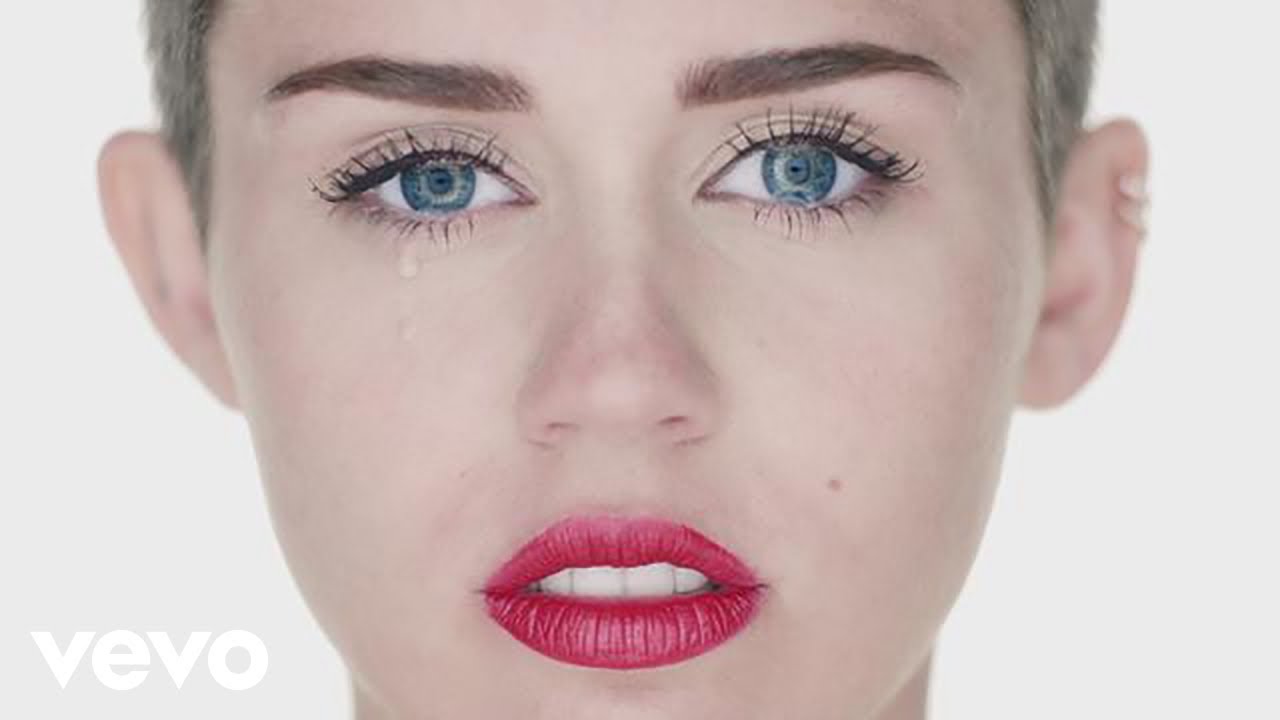 The video consists of extreme close ups of her face as she cries, her facial expression represents her sadness after breaking up with her long term boyfriend Liam Hemsworth. The extreme close up is a typical shot type for music videos.
The music video is very literal with the songs lyrics, as Miley sings ' i came in like a wrecking ball' in which she is on a wrecking ball as it swings in a medium long shot. Which does make sense with the lyrics.

This continues throughout the video as Miley is no longer a innocent little girl, but now a broken women. This is shown through her being a sexual object, which gets her message across. As her clothes were white, which represented purity, has now been taken off and she is naked.
Sinead O’Connor warned Miley not to let them 'prostitute you', although it seems like she is being exploited. Which agree's with Laura Mulvey's theory of women being sexualised.
Lily Allen's hard out here video is meant to be seen as a feminist video as she is tired women being seen in a certain way and being sexualised, but the video appears to be a parody pop video.
 The video starts with her being operated on as it shows how many women try to make themselves perfect throw plastic surgery in order to please men. In which she disagrees with as women shouldn't have to exist only for men.
Her lyrics are in direct contrast with the rest of the music video. As her lyrics state that she 'dont need to shake my ass for you cause i've got a brain' although throughout the music video. Her back up dancers are shaking their bums.

Some of her lyrics does represent her and the music video, as she states she isn't a size 6 but she doesn't care. She is fully clothed and she is still gaining attention.
The whole song and music video is a contradiction but with meaning.


Friday, 5 December 2014
Alex Southam
Agile Films describe Alex Southam on their website as:
‘Alex Southam is an exciting new talent, working in a
dizzying variety of styles across live action and animation. Entirely
self-taught, his inventiveness and creativity have caught the eye with a series
of diverse promos for the likes of the Walkmen, Alt+J and Lianne La Havas. Alex
joined Agile in August 2012.’
He is a one man band, where he does all the camera, lighting, editing by himself, but now he uses a Director of
Photography.
He likes to arrange his music videos as a way that, ‘you can
try new techniques and can have real artistic freedom’. This is why he isn’t keen
on commercials as they don’t allow his freedom. He uses Vimeo to showcase his
videos, this is becoming an increasingly important platform for him. As it is
seen to have a ‘higher status’ than YouTube.
His discovery came with the Tesselate video for Alt J, which
had the budget of £10,000. The video was shot in one day and it had a large
cast, it also contains the special effect called AfterEffect.

The whole video is a recreation of the 'School of Athens' painting.

The video starts starts with 4 extreme close ups of two pairs of eyes, a t-shirt and fingers. Which the 5th close up being a bit faster with the girl standing with two boys.

The video seems to be showing young people in a negative light, as it shows clips of boys fighting, girls in dancing in a sexual way and images associated with gang members.


The lost and found video, by Chase and Status had a £50,000 budget and was shot in Los Angeles using a Steadicam. It had 36 frames per second which was then slowed down. Its influence is Massive Attack’s Unfinshed Sympathy that went for an early 1990s VHS video look.

Unfinished Sympathy was filmed on Pico Avenue in Los Angeles 1991. It was the first ever promo music video to be done in one take. The original ending of the video was to do a, wide angled camera shot, that would slowly crane over the hosuing levels of the street. Although the cameraman was too tired and it became a quick fade-out instead.
Friday, 28 November 2014
Emil Nava

Emil began his career as a runner for the film production company, Blink Productions. Now he freelances for OB Management. After working as a runner graduated to Assistant Director (A.D.) where he would manage the video shoots.
He was signed to Academy, who are the biggest music video
production company, then worked for Between the Eyes. Now currently works
mainly for Pulse.
Emil’s first budget was for the band Kid British and the track Our House
•Budget - £20,000
•Location – Manchester
•Cast – local people
•1 day for filming
•2/3 days for editing
•10 days pre-production
•Demonstrates the very tight timescales
involved

Our house is dadless, is a indie song made by Kid British is a unique song. Which is shot in england.
The busiest for Emil has been that he has made 24 music videos in one year. When he staring shooting videos for independent labels, the budgets would be £5,000 to £10,000. His most expensive video to date has been for Jessie J and the budget was £160,000.

Wild by Jessie J is a dance flow song, which starts off slow which shows the calm before the storm. The beat kicks it when Jessie J looks into the camera. This is a wide shot of both her and the camera.

The next shot is of Jessie starting to lose herself, which fits with the lyrics, as she is feeling alive. This is a medium shot of her facial expressions and hands which relates to this.

Laura Mulvey's theory of the male gaze, is seen here as Jessie J is naked with only leopard prints covering her skin. This is a medium long shot which shows her sexuality, but maybe even her vulnerability. As she is slightly covering herself, with her head down.
Emil began to make adverts which have higher budgets and production values but didn't allow creative freedom. This maybe due to the fact that the advert only lasts 20 seconds and has to focus on the hair, as well as the hair product.
 Lego house was filmed in the University of Hertfordshire, which features Ed sheeran himself and the actor Rupert Gint who is his stalker.
Rupert Gint starts off by lip syncing with Ed Sheeran's voice which makes it seem like its him singing. The fact that they they look similar is uncanny too. He becomes apprent that he is actually stalking Ed Sheeran and wants to be him as he starts to write songs and starts playing the guitar.
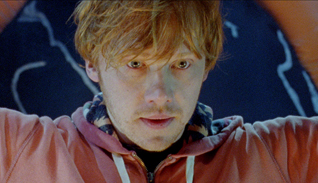
The music video ends with Rupert meeting Ed Sheeran after being kicked off the staged by security. As Rupert is no longer stable and thinks he is Ed Sheeran.
Emil's top tips for production were, use ‘Extreme Close Ups on faces wherever possible’ and ‘Do not shoot whole of video in medium shot/long shot'.

An example of this in the Sinead O'conner song nothing compares to you. Her face alone made this song recognisable, as she is bold.
The lyrics present the feelings of longing from an abandoned lover's point of view. Which fits with the music video, as it sad and gloomy.
Friday, 21 November 2014
Jamie Thraves
 Jamie Thraves is a director who made short films when he was at university. He has been awarded for his short film Calling card, as he wants to get a 'foot in the door' with the video production company factory films. Jamie started by shooting three music videos that cost about £5,000 each.
Many directors in the business know how risky it is, as their livelihood is based on each commission. He tried his lucky by entering his top two videos and then made it.
Radio head Just, was shot in three days with a £100,00 budget.
 The band picked Jamie to
do their music video band after they saw a couple of his experimental short
films. The music video was shot near Liverpool Street Station in London, with scenes of a middle-aged man who lies down in the middle of the pavement outside a
flat. This is shown through a wide medium shot.
The band picked Jamie to
do their music video band after they saw a couple of his experimental short
films. The music video was shot near Liverpool Street Station in London, with scenes of a middle-aged man who lies down in the middle of the pavement outside a
flat. This is shown through a wide medium shot.
 When the man answers them,
the subtitles have now stopped as it leaves the viewer the option to decide
what he said. When the camera zooms out the pavement is now covered with the
crowd of people. They are all lying down just like the man. This is shown through
a wide shot and a crane.
When the man answers them,
the subtitles have now stopped as it leaves the viewer the option to decide
what he said. When the camera zooms out the pavement is now covered with the
crowd of people. They are all lying down just like the man. This is shown through
a wide shot and a crane. The Scientist was popular for its reverse narrative, which employed reverse video. The same idea had been previously used for Spike Jonze's 1996 music video for The Pharcyde's Drop. The Scientist was made in three days with a £200,000 budget. In order for Martin to appear to be singing the lyrics in the reversed footage, he had to learn to sing the song backwards.
 The music video begins with the camera looking down on
Martin who is singing, lying on a mattress. As the camera shot pulls back, the
mattress is seen to be outside. A cyclist cycles past in reverse and Martin
leaps up from the mattress. He starts to walk in reverse throughout the city. This is shown through a low angle crane shot.
The music video begins with the camera looking down on
Martin who is singing, lying on a mattress. As the camera shot pulls back, the
mattress is seen to be outside. A cyclist cycles past in reverse and Martin
leaps up from the mattress. He starts to walk in reverse throughout the city. This is shown through a low angle crane shot.  He then crosses a railway line and into woods, to pick
up his suit jacket as he carries on with his journey. When he gets to his car, he
passes out for a bit. The pieces start to fall into place, as the viewer starts to realise what has happened. This is shown though a wide shot tracking shot.
He then crosses a railway line and into woods, to pick
up his suit jacket as he carries on with his journey. When he gets to his car, he
passes out for a bit. The pieces start to fall into place, as the viewer starts to realise what has happened. This is shown though a wide shot tracking shot.  A woman is shown lying
unresponsive on the ground in front of the car. As the video rewinds backwards,
she is shown flying back in through the broken windshield of the car. The car
rolls back up a hill in the woods and through a broken fence, which as the car
goes through it fixes its self. The car ends with both of them driving back up
the road, and the passenger had removed her seat belt to put her jacket on, causing
her death. This is all shown through a tracking shot in medium.
A woman is shown lying
unresponsive on the ground in front of the car. As the video rewinds backwards,
she is shown flying back in through the broken windshield of the car. The car
rolls back up a hill in the woods and through a broken fence, which as the car
goes through it fixes its self. The car ends with both of them driving back up
the road, and the passenger had removed her seat belt to put her jacket on, causing
her death. This is all shown through a tracking shot in medium. Jamie’s top tip is that you should use the lyrics but try not to be too literal in the music video. Also you should go with the emotion of the lyrics.
Subscribe to:
Posts (Atom)